A little more to explore…
Client project / Private LMS / Bilingual learning / Workflow optimization
KimageLMS.
Optimized an existing WordPress / Tutor LMS Pro training platform for private enrollment, English and Chinese learning, quizzes, progress, certificates and SMTP-based account communication.
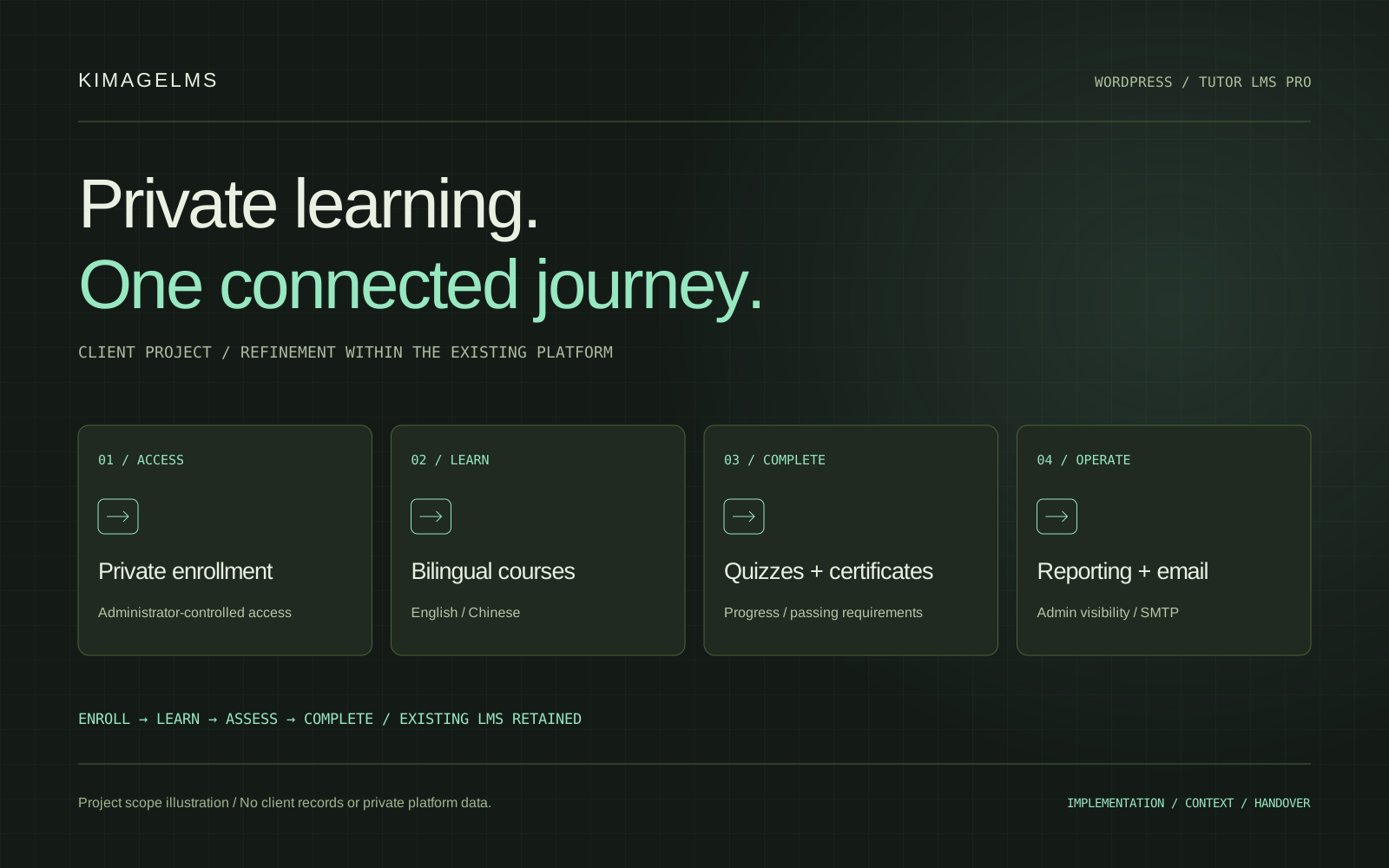
The implementation map
EXPLORE EACH PART OF THE SYSTEM
01 / SYSTEM COMPONENT
Administrator enrollment
Keep access private: administrators manage student accounts and assign courses, rather than exposing open public registration.
ARCHITECTURE OVERVIEW / THIS PORTFOLIO DOES NOT RUN THE CLIENT’S PRIVATE SYSTEM.
Evidence / engagement record
Checks at handover.
| Check | Recorded result |
|---|---|
| Enrollment model | Private; administrator-controlled student access |
| Learning content | English and Chinese courses, lessons and quizzes |
| Completion workflow | Lesson / quiz / course states reviewed and corrected |
| Certificates | Access tied to successful completion requirements |
| Email transport | SMTP configured and test emails sent |
| Final client acceptance | 30 August 2026 |
| Contract closure | 31 August 2026 |
Outcomes and dates reflect the supplied engagement record. No learner counts, completion-rate improvement, uptime guarantee or independent current platform audit are claimed. The platform is private; no public demo URL, learner records or credentials are exposed.
01 / THE IMPLEMENTATION
The problem and context
KimageLMS was an existing WordPress training platform built with Tutor LMS Pro. The client needed a more dependable private learning experience, not a new website or a complete LMS rebuild. Problems affected student access, dashboard navigation, password recovery, completion states and certificate availability. The platform also needed to support English and Chinese learning material while staying manageable for its administrator.
02 / THE IMPLEMENTATION
What this demonstrates
The required workflow combined private access, administrator-controlled enrollment, bilingual courses and quizzes, configurable passing requirements and attempts, progress tracking, completion certificates and useful administrator reporting. Students needed a simple route to their assigned learning material and self-service account recovery. Reliable transactional emails and a cleaner mobile dashboard were also part of the scope, with unnecessary plugins avoided.
03 / THE IMPLEMENTATION
The decisions
I reviewed Tutor LMS configuration, assigned pages, student dashboards, enrollment settings, password workflows, quiz logic, course completion, certificate behavior and the existing plugin stack. The aim was to use native Tutor LMS Pro features wherever they met the requirement, with targeted WordPress-level adjustments where necessary. This kept the intervention focused on the existing platform instead of introducing a separate membership or learning system.
04 / THE IMPLEMENTATION
Content and data
The learning structure accommodated English and Chinese courses, lessons and assessment material without separate websites or an unnecessarily complex multilingual setup. Quizzes were configured with passing requirements, permitted attempts and result tracking. Assessment outcomes were considered alongside lessons and course requirements so that a failed or unfinished learning path was not incorrectly represented as successfully completed.
05 / THE IMPLEMENTATION
Implementation
Public registration was removed from the normal journey and the administrator retained control over student accounts and enrollment. I investigated the existing retrieve-password route and login/reset behavior, restored password setup and recovery workflows, and reconciled lesson, quiz and overall course-completion states. Certificate eligibility followed the required learning and assessment completion. Administrator views exposed student progress and quiz results. SMTP was configured and test emails were sent for the account and applicable LMS communication workflows.
06 / THE IMPLEMENTATION
Validation approach
The student dashboard was simplified around enrolled courses. Course cards and navigation were refined to make the route from login to assigned course, curriculum, assessment and completion easier to follow. Typography, spacing, content widths and dashboard presentation were reviewed on desktop, tablet and mobile. The existing brand and Tutor LMS components were retained rather than being replaced by an unrelated interface.
07 / THE IMPLEMENTATION
The result
The delivered platform connected controlled enrollment, bilingual learning, assessment, progress and certificates within the existing WordPress / Tutor LMS Pro architecture. Students had a clearer route to their assigned courses and completion credentials, while administrators could review progress and assessment outcomes. Account recovery and SMTP-based communication supported the access journey without requiring an additional membership stack.
08 / THE IMPLEMENTATION
Evidence and limitations
QA covered the full student journey: administrator enrollment, account access, course visibility, English and Chinese material, quizzes, passing rules, attempts, progress, completion, certificates and email delivery. Client feedback and video observations helped reproduce remaining issues. Where lesson, quiz and course states disagreed, they were checked together. The supplied record states that final client acceptance was received on 30 August 2026; the contract closed on 31 August 2026.
09 / THE IMPLEMENTATION
Handover and next steps
The platform was handed over as a focused private training environment using its existing architecture. Native LMS functionality was preferred to unnecessary plugin additions to keep maintenance practical. This public case includes the workflow and documented acceptance outcome while keeping the private training URL, student records, access details and commercial terms out of the portfolio.
Have a related task?
Bring the workflow.
We’ll clarify the next scope.
TeachSafer
Let’s scope the next task
GOOD WORK STARTS WITH A CLEAR BRIEF.
What needs
moving forward?
A WordPress issue, a small feature or a backlog item? Start with one clear brief. Availability, scope and timing are agreed before work begins.
SCHEDULED COLLABORATION / PKT · UTC+05:00
new-inquiry.md