A little more to explore…
Client project / WordPress recovery / Malware cleanup / SEO spam remediation
7StarLife.
WordPress malware and core-file cleanup for an online magazine affected by SEO spam and reported availability issues. Submitted a successfully processed sitemap and requested removal of 11 checked Spanish spam URLs, while protecting legitimate editorial pages.
Project URL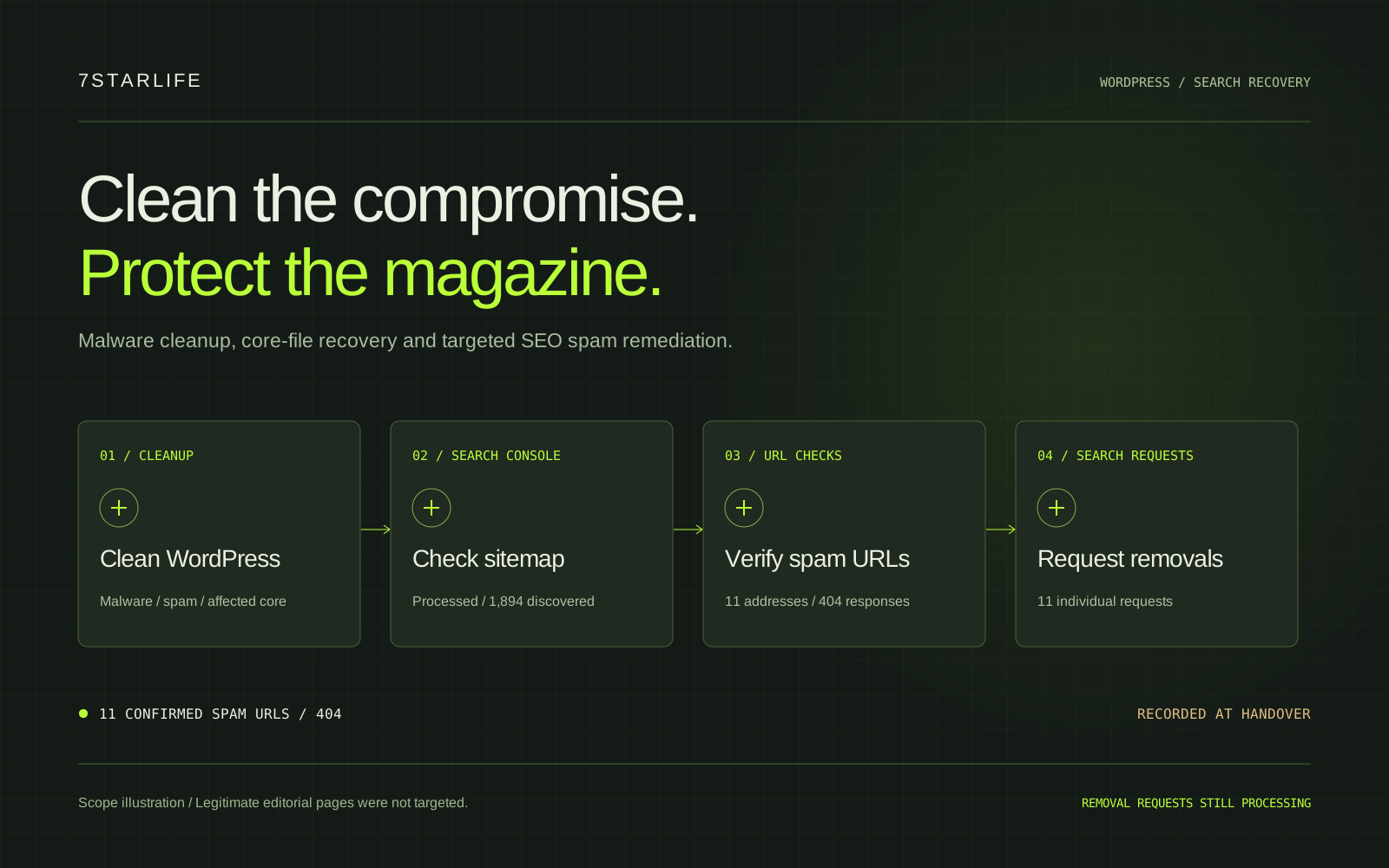
The implementation map
EXPLORE EACH PART OF THE SYSTEM
01 / SYSTEM COMPONENT
WordPress cleanup
Removed malicious content, injected spam and malware. Cleaned affected WordPress core files and other compromised areas, addressing the website issues associated with the compromise.
ARCHITECTURE OVERVIEW / THIS PORTFOLIO DOES NOT RUN THE CLIENT’S PRIVATE SYSTEM.
Evidence / engagement record
Checks at handover.
| Check | Recorded result |
|---|---|
| Live XML sitemap | Successfully processed by Google |
| Pages discovered through the sitemap | 1,894 |
| Spanish spam URLs verified | 11 |
| HTTP status of the checked spam URLs | 404 Not Found |
| Individual removal requests submitted | 11 |
| Removal request status at handover | Processing |
| Legitimate pages targeted for removal | None |
These checks reflect the supplied engagement record at handover. The 11 checked spam URLs returned 404; Google's individual removal requests were still processing. Complete disappearance from search results was not claimed. Sitemap discovery does not mean that every discovered page was indexed.
01 / THE IMPLEMENTATION
The problem and context
7StarLife, an online magazine, contacted me after its WordPress website began displaying a white screen and 503 Service Unavailable errors. Readers could not access the magazine and the owner could not enter the WordPress dashboard. The client also found unrelated Spanish-language product pages under the magazine’s domain in Google Search, indicating an SEO spam compromise. Repeated prompts to confirm an outdated administrator email address and missing confirmation emails were additional reported concerns. Those email concerns form part of the initial context; the supplied result record does not establish a separate completed email-delivery repair.
02 / THE IMPLEMENTATION
What this demonstrates
The work separated cleanup of the website from recovery of its search presence. First, remove the malicious content and address compromised WordPress files. Then identify spam URLs still represented in Google, verify what those addresses returned and submit targeted removal requests. Legitimate magazine articles and editorial pages needed to remain outside the removal scope. The success criteria were concrete cleanup and handover checks, rather than a promise that every search result would disappear immediately.
03 / THE IMPLEMENTATION
The decisions
I handled the engagement in two stages. The website stage removed malicious content, injected spam and malware, cleaned affected WordPress core files and other compromised areas, and addressed website issues associated with the compromise. The search stage reviewed indexing information in Google Search Console and the spam addresses visible in indexed-page examples and public search results. Treating these stages separately kept an important distinction clear: cleaning a website does not by itself prove that Google’s existing search results have already updated.
04 / THE IMPLEMENTATION
Content and data
The search review focused on unrelated Spanish-language product URLs rather than legitimate editorial content. The live XML sitemap was verified and submitted to Google Search Console. The sitemap was successfully processed and showed 1,894 discovered pages. That is the recorded sitemap-discovery figure, not a claim that all 1,894 pages were indexed or that the entire index had been independently audited. Each candidate spam URL was considered individually before a removal request was submitted.
05 / THE IMPLEMENTATION
Implementation
For the search-recovery stage, I checked the HTTP response of every URL selected for removal. Eleven Spanish spam addresses were verified and returned 404 Not Found. I then submitted 11 individual Google removal requests for those confirmed spam URLs. No legitimate magazine page was targeted. This kept removal actions bounded to the unwanted addresses actually checked during the engagement, rather than using a broad removal scope that could affect genuine content.
06 / THE IMPLEMENTATION
Validation approach
The handover checks covered the live sitemap’s processing status, the number of pages discovered through that sitemap, the count of selected spam URLs, their HTTP responses and the status of the submitted removal requests. The 11 checked spam URLs returned 404, confirming that those addresses were no longer serving the spam pages when checked. The record does not establish a complete security certification, an independent current live audit, a guaranteed uptime figure or a final Google indexing outcome.
07 / THE IMPLEMENTATION
The result
The website cleanup removed malicious content and addressed compromised WordPress files. Search recovery supplied Google with a successfully processed current sitemap and submitted 11 individually verified spam URLs for removal. At handover, the recorded result was 11 checked 404 responses and 11 removal requests with status Processing. These are distinct outcomes: the unwanted pages were unavailable at the checked addresses, while Google’s removal workflow had not yet been confirmed complete.
08 / THE IMPLEMENTATION
Evidence and limitations
The portfolio results are grounded in the supplied engagement account. No complete disappearance of spam from search results is claimed because the removal requests were still processing at handover. The sitemap figure of 1,894 describes pages discovered through the sitemap, not an indexed-page total. The initial administrator-email concerns are not turned into an unsupported claim of a completed SMTP or account-email fix. No ranking recovery, traffic increase, revenue improvement or permanent immunity from future compromise is asserted.
09 / THE IMPLEMENTATION
Handover and next steps
The handover distinguished completed website cleanup and URL-response checks from search requests still awaiting Google’s processing. Any later confirmation that the spam results disappeared should be recorded as a follow-up outcome, rather than backdated into this case. The documented scope remains WordPress malware/core-file cleanup, sitemap submission and targeted removal requests for the 11 confirmed spam URLs. Legitimate editorial pages were preserved outside the removal scope.
Have a related task?
Bring the workflow.
We’ll clarify the next scope.
Veritano Consulting
Let’s scope the next task
GOOD WORK STARTS WITH A CLEAR BRIEF.
What needs
moving forward?
A WordPress issue, a small feature or a backlog item? Start with one clear brief. Availability, scope and timing are agreed before work begins.
SCHEDULED COLLABORATION / PKT · UTC+05:00
new-inquiry.md